Just two hours over the Germany-Czech border, lies the city at the heart of Old World Europe: Prague. (Or Prag. Or Praha, whichever you prefer.)
After our weekend in Dresden and Wittenberg, Melody and I boarded our train to Prague, which was in no way dirty, rickety, or a remainder from DDR times. Despite the general shadiness of the train, the train ride, which follows the Vltava River was especially lovely with the changing leaves.
Needless to day, I had to attempt to snap some blurry pictures through the train windows.


Arriving in Prague's main station was quite overwhelming. Unlike the Romance or Germanic languages, which bear some resemblance to English (making it easier to jump to some kind of assumption about what in the world that sign says), Czech is baffling and totally unrecognizable.
And while we're on the "baffling" front, let's talk about Czech korunas and how awesome you feel holding a 2000 koruna note (which is about 77 Euros or about 104 US dollars, for those of you playing at home). Czech korunas have coinage, but the lowest value in their currency system is 1 koruna coin, so there are no "cents". For example, the average price for a bottle of water is about 30 or 40 koruna.

Needless to say, whenever you spend some money, you first start a bit at the idea of spending 100 + korunas for, well, anything, but then you realize that your 300 koruna meal is actually only about 10 Euros and then you feel really powerful.
 |
| And somehow spending money becomes really easy. |
 |
| One of the gates of the St. Charles Bridge |
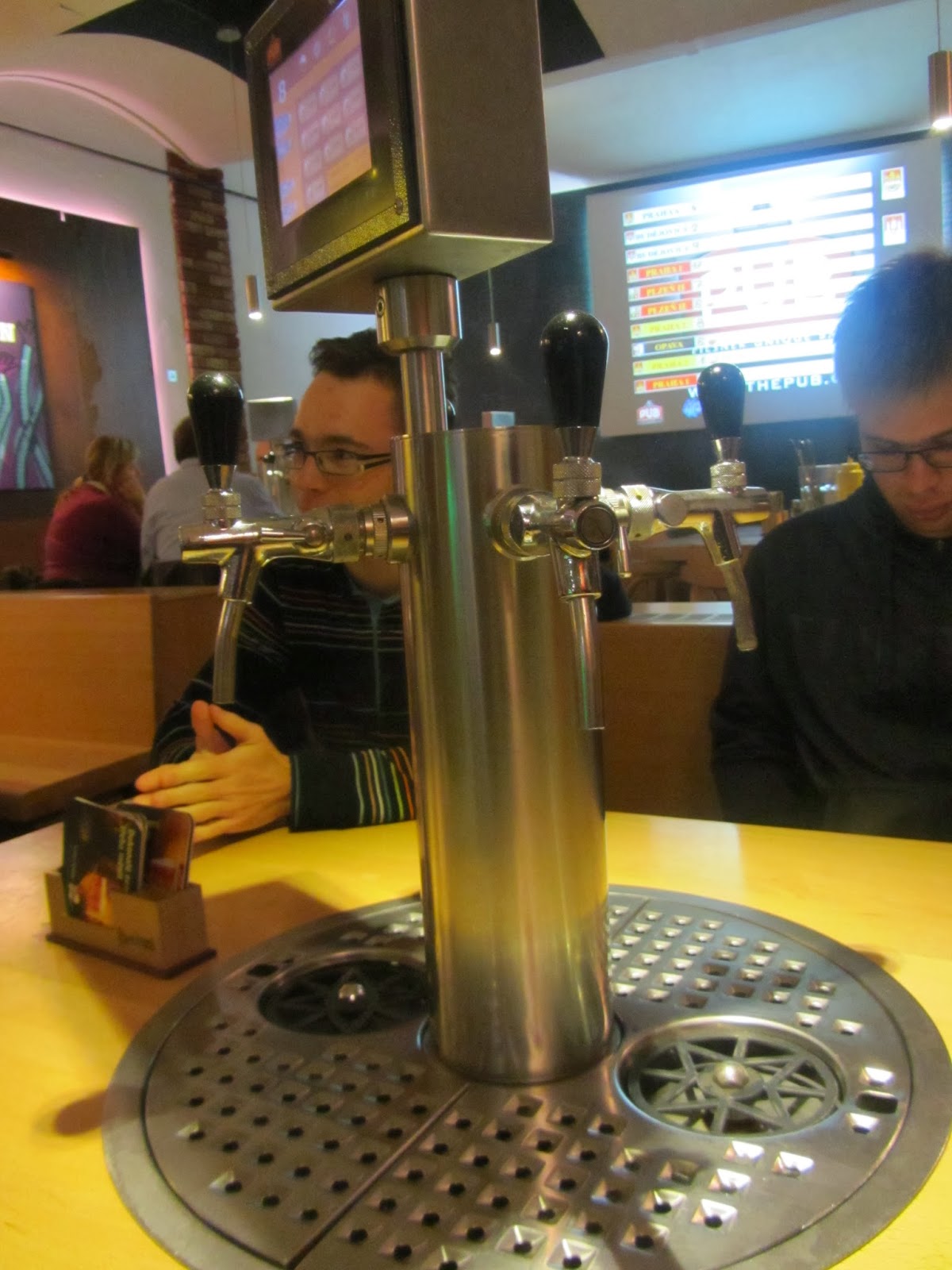
I'm not really a beer person (at all actually - I tend towards fruity drinks that are pink, shocking, I know), but real Pilsner-Urquell straight from the tap is pretty tasty. Also the fun of pouring your own beer is not to be underestimated either.

Beer pairs perfectly with Czech foods, which are quite similar to German ones - meat, potatoes, bread, cheese, and the possibility that they all can be deep fried. One of the Czech specialities is deep fried Edam cheese - also known as Smažený sýr. (They tend to serve it with a small side salad to give the appearance that you're not just eating deep fried cheese for dinner.)

Day Two: A Day Trip to Kutná Hora
We had all agreed to take part in a day trip to the city of Kutná Hora, which is only an hour from Prague. We planned our tour guide by the city center and the (vastly overrated) astronomical clock. The winding path to the town square is filled with shops, selling everything from postcards to matryoshka dolls to garnets. (Side note: Garnets and amber are very cheap and easy to find in Prague, for those of you who like bling.) Even though it was the off season in Prague, you can see the masses of tourists in the square.


Our tour guide led us through the city on the way to the train station.
 |
| City workers refinish the cobblestones on gunpowder tower. (Definitely not a job for me!) |
 |
| Although it looks like a mosque, it's actually the Spanish Moor inspired Jewish synagogue. |
After the veins of silver had been tapped, even dangerously so, Kutná Hora fell into the back of history books and was soon forgotten as Bohemia was eclipsed by the Austro-Hungarian Empire.
Nevertheless, Kutná Hora still has many sights to see and its a very cute little town.
Yet one of its main attractions, which draws the tourists to Kutná Hora, happens to be very macabre. A small chapel, the Sedlec Ossuary, is the last remnant of an old monastery.
The chapel is, well, interesting to say the least.
 |
| A comforting sight when you walk in for Mass. |

Okay, so long story short, the chapel became a popular place to bury people after one of the monks brought soil from Golgotha in 1278. And the bodies/bones kept stacking up, following the wars and diseases that swept Bohemia.
Then in 1511, as the legend goes, they assigned the task of exhumation and bone piling to a half-blind monk. Legend says that this blind monk was the one who began arranging the bones into intricate designs.
But since legends are mostly B.S. anyway, I would like to take a moment to tell you that the noble family of Schwarzenberg hired a totally not weird and crazy woodcarver in 1870 to rearrange the bones into the piles and sculptures (is that the right word? I don't know).
It is estimated that the bones of nearly 70,000 people are on display for the nearly 200,000 tourists, the chapel receives every year.
Anyway, have some photos! (You might not want to be eating while you read this post. Sorry.)
 |
| A good artist always takes credit for his work. |
 |
| This the famous skeleton chandelier which makes use of every bone in the body. Fun. |

 |
| The Schwarzenberg family crest, which in reality looks like this. Also note that the lower right hand image of the shield is of a crow picking out a Turk's eyes. Very PC. |
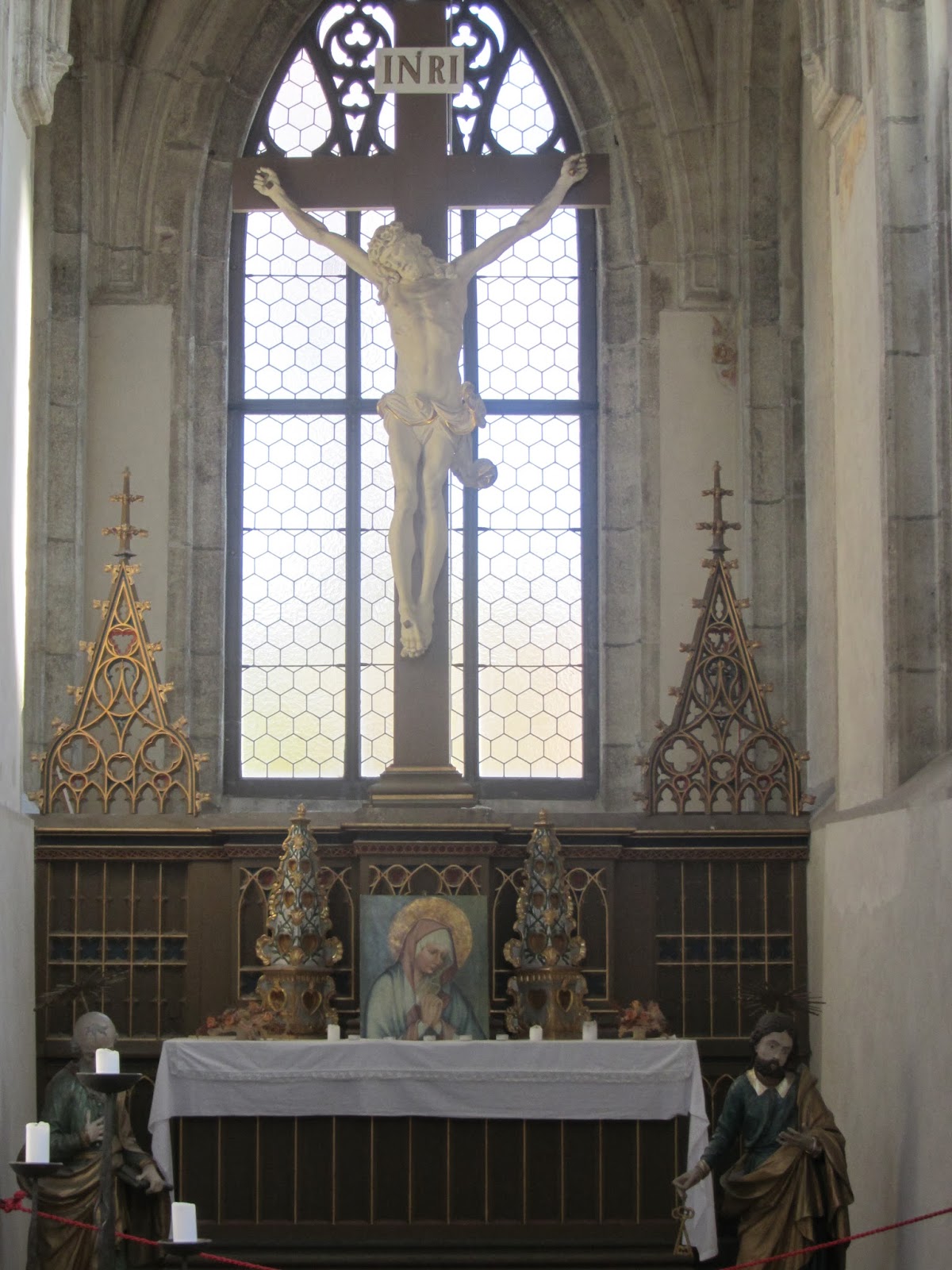

When you go outside to catch your breath from the macabre sight within, the views around the chapel are also quite interesting.


From the Sedlec Ossuary we walked to St. Barbara's Cathedral, which was built during the height of the silver mining industry. (Okay, it took almost 600 years to build.)
Anyway, it's a lovely Gothic cathedral dedicated to the patron saint of miners.

 |
| This old fresco depicts the many facets of silver mining and coin minting. |
 |
| This fresco depicts the punishment for thieves: They have to hold the silver pieces in place for the minter. Needless to say, fingers were smashed in the process. |

 |
| The vaulted ceilings are decorated with the crest of families and guilds that donated to the church. |

 |
| Side altar dedicated to St. Barbara |

 |
| A depiction of a silver miner, wearing traditional mining garb. |


Our tour took us to a restaurant with a view back to the church. Delicious Czech food (and beer) was consumed.

 |
| In case you wondering, Czech Budweiser is still in lawsuits with America's King of Beers. |

After lunch, we headed back down toward the train station. Our day trip to Kutná Hora was a success and I enjoyed myself (well, except for the Bone Chapel).


 |
| Leftover tower of the old Bohemian coin mint |
 |
| Back in downtown Prague. |
Day Three: Walking Tour Through Prague
The next day, we rose early(ish) and headed to the city center again to begin our walking tour of Prague. Instead of recapping all the sights, I'm just going to include a little summary underneath and let the pictures tell the story themselves.
Prague is a visual feast and I hope my terrible photos do it justice.
 |
| The Astronomical Clock, which does a little show on the hour, every hour. |
 |
| The Gothic Church of Our Lady faces one end of the Old Town Square... |
 |
| While the baroque Hussite church of St. Nicholas is opposite. |
 |
| A statue of Jan Hus who was the Hipster Protestant™: He hated the Catholic Church before it was cool, Martin. |
 |
| One of Prague's most beloved sons, Franz Kafka, is fondly remembered, despite the fact that his works were not translated into Czech until the early 1990s. |

 |
| The Czech symphony orchestra house |
 |
| Complete with a statue of Dvořák. |
 |
| The Old New Synagogue (And no, that's not a typo.) |
 |
| The Prague Metronome - actually does move back and forth! It replaced the world's largest statue of Stalin that looked down over the city. |
 |
| The Spanish Synagogue |

 |
| The Kafka statue. Delightfully creepy. |
 |
| Wenceslas Square |
 |
| The Estates Theatre in Prague. Mozart chose this theater to premiere his opera Don Giovanni. (Mozart also really loved Prague.) |
 |
| A view to the St. Charles' Bridge from another bridge |
 |
| WWII Memorial. Note that the war is shown to begin in 1938 when England and France signed the appeasement of Hitler, turning their backs on Czechs. |
 |
| Statues to astronomers Tycho Brahe and Johannes Kepler |
 |
| One of the monasteries in Prague |

 |
| View from the monastery gardens |
 |
| Oh look, it's me. |
 |
| The Schwarzenberg place near the old royal palace. |
 |
| Another view of the stone work on the palace |
 |
| A statue of the first president of Czechoslovakia, Tomáš Masaryk, looking over his city. |
 |
| Entrance to the Royal Palace. The President of the Czech Republic is still in residence there. They have a changing of the guard like Buckingham Palace but with a little less pomp. |
 |
| St. Vitus Cathedral Construction began in 1344 and ended with its consecration in 1929. |
 |
| The interior of the church Sorry for the crooked shot. |
 |
| The only non-stained glass window is the painted window done by Alphonse Mucha (no link here, but he'll pop up later in the entry) |


 |
| Many of the old gothic structures were covered by baroque facades by Empress Maria Theresa |
We spent our night at the hostel, where I finally learned the finer points of euchre. (Note to self: Don't lead with the Left Bauer.) And with the very generous help of Cathy and Alex, we crushed the boys.
Day Three was a success.


Day Four: Museum Day
Inevitability, all good things must come to an end. Our last day was spent wrapping up the sights we wanted to see before we left.
Our first stop was in St. Nicholas church, which is a Hussite church. The photos alone speak to the church's baroque beauty.


Our next stop was the Alphonse Mucha museum.
It will probably not come as a shock that I am simply in love with art nouveau. And for many years, Mucha has been one of my favorite artists and my favorite art nouveau artist.
Needless to say, I was more than thrilled to see Mucha's best works in person. (Also, gift shop!)
 |
| "Summer" - One of a series of four panel prints depicting the seasons |
 |
| Another one of Mucha's quartet pieces: "Times of Day" My favorite piece is the far left, "La Nuit" (The Night). |
Mucha began as artist for the purely superficial and the commercial, but his career took a turn when he began to paint promotional art to support Czech and Slavic nationalism.
 |
| This poster encouraged Czechs to support the arts in school in more, especially music. |
Anyway, if you love art, check out the little Mucha museum while you're in Prague. I guarantee you'll fall in love a little bit. (And probably drop some cash at the gift shop too.)
Our last stop was the Franz Kafka museum, which was as weird, dark, and trippy as one would expect.

Walking through the dimly lit museum, while listening to strange music and sounds, looking at display boxes, and puzzling through art installations was, shall I say it...a kafkaesque experience. (You knew that was coming.)
The museum was divided into two parts: "Kafka in Prague" (which described Kafka's personal life) and "Prague in Kafka"(which described Kafka's works and Prague's influence on them). A good chunk of the museum is in Germany and isn't translated into English, so non-German speaking visitors beware.
Although I'm not the biggest Kafka fan, the museum was cool. In a slightly overwhelming and sickening way, but cool nevertheless.
Prague, in a nutshell, is an amazing city. And I know we only scratched the surface of this strange and ever-changing city.
It has culture enough to satisfy the most sophisticated, history enough to see the transformation of Europe throughout nearly time period (Also: defenestrations. Yes, plural. There have been at least three or up to five, depending on how you count.), and beer and deep fried goodness enough to give you an excuse to walk around a lot.
Even though Prague is the go-to city for tourists to Europe right now, I highly recommend going! (But maybe in the off season, if you don't want to get trampled to death.)
Lots of Love,
Your Humble Blogger
NEXT POST: Tour of the North (Part I) - Bremen and Hamburg!







.jpg/437px-RAFAEL_-_Madonna_Sixtina_(Gem%C3%A4ldegalerie_Alter_Meister,_Dresde,_1513-14._%C3%93leo_sobre_lienzo,_265_x_196_cm).jpg)
